
Hong Kong stock market hours, holidays and severe weather
Disclaimer: For educational purposes only, not investment advice. You are responsible for your investment decisions.
Hawai (Fxcns.com) is not liable for any resulting losses.
Knowing when the Hong Kong market is open helps you plan orders and keep up with market news. This guide explains regular securities trading, the opening and closing auctions, and arrangements for holidays and severe weather. Derivatives follow separate schedules, which you should check for each product.
1. Hong Kong securities trading hours
Regular trading hours
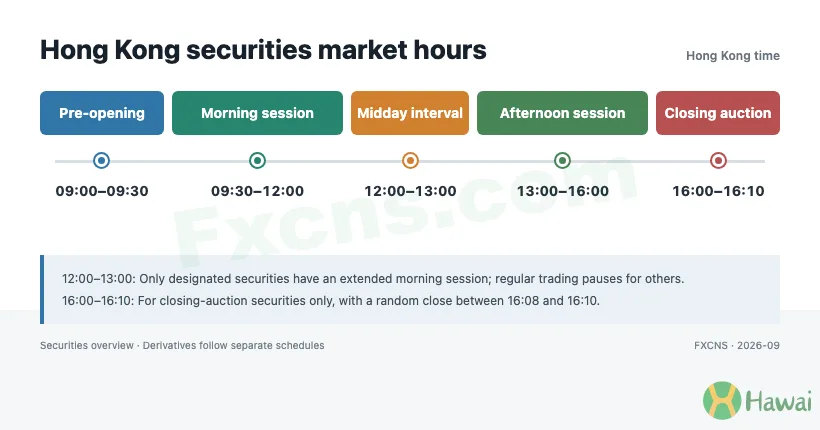
On a full trading day, regular securities trading takes place during the following sessions. All times in this article are Hong Kong time.
- Morning session: 09:30 - 12:00
- Afternoon session: 13:00 - 16:00
An extended morning session from 12:00 to 13:00 is available for designated securities only. Other securities pause trading during this interval. Check HKEX’s list of eligible securities and the applicable arrangements.
Auction sessions
The securities market has a pre-opening session and a closing auction session. The full-day schedule is set out below; order rules vary by phase.
- Pre-opening Session: 09:00 - 09:30
- 09:00 - 09:15: Entry of buy and sell orders
- 09:15–09:20: No-cancellation period. Orders already entered cannot be amended or cancelled; eligible at-auction orders may still be entered.
- 09:20 to no later than 09:22: orders are matched at a randomly determined time.
- After matching until 09:30: blocking period; no orders may be entered, amended or cancelled.
- Closing Auction Session: 16:00 - 16:10
- 16:00–16:01: reference price fixing; 16:01–16:06: order input.
- 16:06–16:08: no-cancellation period; orders cannot be amended or cancelled.
- 16:08–16:10: random closing period.
The pre-opening auction brings together buy and sell orders to establish an opening price. The closing auction determines the closing price of eligible securities. Check which orders are permitted at each stage before placing one.
After-hours trading in derivatives
Some HKEX derivatives have an after-hours trading session, often called the night session. This does not extend trading in shares on HKEX into the night.
- For many eligible contracts, the night session runs from 17:00 to 03:00 the next day. Hours vary by product, contract and trading day.
Not all derivatives offer after-hours trading. Check the relevant contract specifications for opening times and any special arrangements on the last trading day.
2. Market holidays and closures
Annual holiday calendar
The Hong Kong securities market is normally closed on weekends and designated public holidays. Common holidays include those listed below. This is not a complete closure calendar: check the HKEX calendar for the relevant year, including substitute holidays.
- New Year’s Day
- Lunar New Year
- Ching Ming Festival
- Good Friday
- Easter Monday
- Buddha’s Birthday
- Labour Day
- Dragon Boat Festival
- HKSAR Establishment Day
- National Day
- Chung Yeung Festival
- Christmas Day
Trading days that fall on Christmas Eve, New Year’s Eve or Lunar New Year’s Eve are normally half-days; check the annual calendar for the exact dates. The morning session ends at 12:00, with no extended morning or afternoon session. Eligible securities then enter the closing auction, which ends at a random time between 12:08 and 12:10. Check derivatives and after-hours schedules separately.
Severe-weather arrangements
HKEX introduced severe-weather trading on 23 September 2024. The market now follows its scheduled trading calendar when either of the following warnings is in force, instead of automatically closing under the former arrangements:
- A No. 8 or higher typhoon signal
- A Black Rainstorm Warning
HKEX may announce additional measures in exceptional circumstances, so keep an eye on its market notices.
3. How trading hours affect investors
Knowing the trading schedule helps investors plan orders, review market announcements and manage trading risk.
- Review information: Use the midday interval to read announcements and other public information before afternoon trading begins.
- Monitor other markets: Compare Hong Kong, Mainland A-share and US trading hours to understand how news from different markets can affect prices.
- Manage risk: Plan trades around market information and your own risk tolerance. Do not assume severe weather means the market will close.
News released during the midday interval may affect prices when afternoon trading begins, but the market’s response is uncertain. Assess the news alongside market liquidity and the risk of price movements.
4. Hong Kong trading hours in a global context
When comparing market hours, distinguish daytime share trading from after-hours derivatives trading:
- Hong Kong daytime share trading partly overlaps with Mainland A-share trading, so both markets may react to the same news at the same time.
- Hong Kong daytime share trading does not overlap with the regular US equity session. US pre-market, after-hours and other extended sessions are separate.
- After-hours trading in some HKEX derivatives overlaps with the regular US equity session. The overlap depends on the contract’s hours and US daylight-saving time.
Overlapping sessions do not, by themselves, create arbitrage opportunities. Even when markets are open at the same time, price differences, trading costs and execution risks still matter.
5. Practical checks for new investors
New Hong Kong market investors can begin with a few practical checks:
- Use the latest HKEX calendar to record trading hours, holidays and half-days for the products you trade.
- Consider setting aside 15 minutes before the open and again before the close to review market news and check your orders. This is a planning suggestion, not an exchange rule.
- Use the midday interval to review morning activity and check your afternoon trading plan.
- Watch for HKEX announcements about temporary changes to trading hours.
These habits can help you avoid missing an opportunity to place an order, but they cannot guarantee investment results.
6. Conclusion
Trading hours and market closures directly affect order windows, price formation and risk management. Investors should:
- Know the differences between regular trading, auction sessions and half-days.
- Understand how the opening auction sets prices, and use the midday interval to review public information.
- Distinguish daytime share trading from after-hours derivatives trading when comparing markets.
- Follow HKEX announcements about severe weather and exceptional circumstances.
- Keep up with market rules and plan trades with your own circumstances in mind.
HKEX may revise its trading arrangements from time to time. Refer to its latest rules and market calendar for any changes.
This article explains market hours and calendars; it is not investment advice. Before placing an order, check the rules for the relevant security or derivative and the latest HKEX announcements.