
What are U.S. stocks? Major exchanges, indexes, and trading hours
Disclaimer: For educational purposes only, not investment advice. You are responsible for your investment decisions.
The term “U.S. stocks” generally refers to shares traded in U.S. securities markets. If you are new to U.S. stocks, start with three questions: Where do stocks trade, what do common indexes tell you, and when can you trade? This article uses those questions to explain the main rules and features of the U.S. stock market.
1. What is the U.S. stock market?

The U.S. stock market allows investors to buy and sell shares in U.S. companies and some international companies. The New York Stock Exchange and Nasdaq are two prominent exchanges. Understanding U.S. stocks therefore involves learning about both the listed companies and the markets where their shares trade.
2. A brief history of the U.S. stock market
The history of the U.S. stock market dates back to the late 18th century. In 1792, 24 brokers signed the Buttonwood Agreement in New York, laying the foundation for the New York Stock Exchange (NYSE). As markets developed and trading technology advanced, other exchanges, including Nasdaq, were established, gradually shaping the market we know today.
3. Major U.S. stock exchanges
Major exchanges in the U.S. stock market include:
- New York Stock Exchange (NYSE): With a history dating back to 1792, the NYSE is one of the world's largest stock exchanges, known for its listing requirements and trading floor. An exchange's listing and trading rules provide a framework for the market to operate, but they do not make investing in its listed stocks risk-free.
- Nasdaq: Established in 1971, Nasdaq was the world's first electronic stock market and is home to many technology companies and other innovative businesses. Technology companies are an important part of Nasdaq, but they are not the only businesses listed there.
- Other exchanges: These include NYSE American and the stock exchanges operated by Cboe. NYSE American carries on the legacy of the former American Stock Exchange (AMEX). Cboe operates both equities and options markets, which are distinct from one another.
4. Key features of the U.S. stock market
The U.S. stock market has the following features, although conditions can vary by stock and trading session:
- High liquidity: Liquidity describes how easily a stock can be bought or sold and how much a trade may affect its price. The U.S. stock market is actively traded overall, but conditions differ across stocks and trading sessions. Being easy to trade does not mean a stock's price cannot fall.
- High transparency: Listed companies must disclose financial reports and other material information as required by regulation, giving investors a basis for evaluating a business. Disclosure requirements do not guarantee that information is free of omissions or errors, so investors still need to assess it carefully.
- A broad range of choices: Listed companies span many industries, giving investors a range of choices and opportunities to diversify. Whether diversification reduces risk depends on which stocks you buy and how likely they are to rise or fall together.
- International participation: In addition to U.S. companies, many international companies list in the United States, giving investors access to businesses from different countries and regions.
5. Major U.S. stock indexes
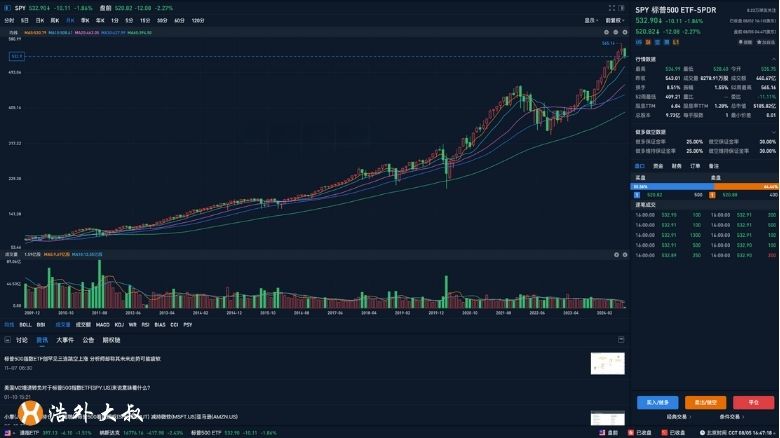
A stock index summarizes the price movements of a group of stocks, helping investors follow that group's overall performance. Different indexes include different stocks and use different calculation methods, so they may reflect different aspects of market performance. The following indexes are commonly used to track U.S. stocks:
- Dow Jones Industrial Average (DJIA): The DJIA consists of 30 U.S. blue-chip companies. Blue-chip companies are generally large, well known, and long established. The index is price-weighted, meaning stocks with higher share prices have greater weight. It reflects these companies' share price performance and should not be treated as a direct measure of the overall U.S. economy.
- S&P 500: Covering 500 large U.S. companies, the S&P 500 is a common benchmark for U.S. large-cap stocks. Large-cap stocks are shares in companies with a high total market value. I usually use the S&P 500 as one of my reference points for following U.S. stock market trends.
- Nasdaq Composite: This index covers eligible stocks listed on Nasdaq. Technology stocks have a significant influence on it, but the index is not limited to technology stocks.
- Nasdaq-100 (NDX): The Nasdaq-100 methodology selects 100 large non-financial companies listed on Nasdaq, primarily by market capitalization. It focuses on large companies, unlike the broader Nasdaq Composite. Although technology companies have a significant influence on the Nasdaq-100, it is not a technology-only index.
6. Who invests in U.S. stocks?
Participants in the U.S. stock market include individual and institutional investors, based both in the United States and abroad. Individual investors typically open accounts with securities brokers to trade. Institutional investors include hedge funds, pension funds, and insurance companies. International investors can also trade U.S. stocks through brokers, but they first need to check whether a broker offers access to U.S. stocks and whether they meet its account-opening requirements.
7. U.S. stock market trading hours
Regular U.S. stock trading hours are generally Monday through Friday, 9:30–16:00 U.S. Eastern Time. Exchanges close for market holidays and close early on some trading days. On Nasdaq, for example, pre-market trading runs from 4:00–9:30 and after-hours trading from 16:00–20:00.
Available trading hours and participation requirements vary by broker, so check the schedules and conditions published by the exchange and your broker. Pre-market and after-hours sessions generally have lower liquidity and greater price volatility. When converting these hours to Beijing time, also account for the difference between U.S. daylight saving time and standard time.
8. Summary and perspective
In my view, beginners do not need to rush to memorize every exchange and index name. It is more useful to understand the questions each one answers. Exchanges tell you where stocks trade, indexes help you follow the performance of a group of stocks, and trading hours determine when you can place orders. Understanding these distinctions matters more than simply remembering the terms.
Market regulation and investor protection mechanisms do not guarantee investment returns or prevent losses caused by falling securities prices. Learning the market rules is only part of preparing to invest. When deciding whether and how to participate, you still need to consider your own risk tolerance. If you have questions about the basic concepts in this article, feel free to leave a message in the group.