
US circuit breakers: halt thresholds, reopening and orders
Disclaimer: For educational purposes only, not investment advice. You are responsible for your investment decisions.
Can trading suddenly stop when US stocks plunge? How long does a halt last, and what happens to the sell orders and stop orders you have already placed?
Here is the short answer: US market-wide circuit breakers use the S&P 500's decline from its previous trading day's close, with thresholds of 7%, 13% and 20%. Level 1 and Level 2 normally pause trading for 15 minutes. Level 3 stops trading for the rest of the day.
But 15 minutes is not a guarantee that every stock will resume trading at the same time, and a halt does not prevent further price declines. If you hold shares or have open orders, you also need to know whether those orders remain active and what prices you might receive when trading resumes. We explain the rules first, then illustrate them with hypothetical figures.
All times in this article are US Eastern Time (ET). The rules were checked as of 31 October 2026.
1. What triggers a circuit breaker, and how long does trading stop?
This article covers market-wide circuit breakers, or MWCBs. They are triggered by the S&P 500's overall decline; individual stocks do not all have to fall by the same percentage.
A pause caused by a sharp move in an individual stock is a separate mechanism. The 7%, 13% and 20% thresholds below do not apply to it. Market-wide circuit breakers are also not a symmetric system of daily upper and lower price limits.
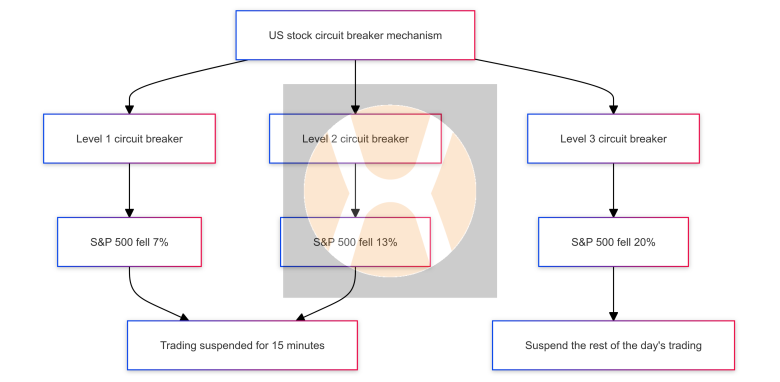
Overview of the three circuit-breaker thresholds. See the table below for the time conditions for Levels 1 and 2, and section 3 for how individual stocks resume trading.
According to the SEC's explanation of stock market circuit breakers, the main rules for a normal trading day with a 4:00 p.m. close are:
| Level | S&P 500 decline from the previous close | When it can trigger | Trading arrangements |
|---|---|---|---|
| Level 1 | 7% | During regular trading hours, before 3:25 p.m. | Normally a 15-minute halt, followed by reopening procedures |
| Level 2 | 13% | During regular trading hours, before 3:25 p.m. | Normally a 15-minute halt, followed by reopening procedures |
| Level 3 | 20% | At any time during regular trading hours | Trading stops for the rest of the day |
The cutoff for Level 1 and Level 2 is 3:25 p.m.. On a normal trading day with a 4:00 p.m. close, that is 35 minutes before the close. At or after 3:25 p.m., a 7% or 13% decline will not trigger a new Level 1 or Level 2 market-wide halt. The cutoff does not apply to Level 3.
The decline is always measured from the previous trading day's closing level, not that day's opening level or the level when trading last resumed. The next section illustrates the calculation.
2. A hypothetical 5,000-point close: calculating the three thresholds
Suppose the S&P 500 closed at 5,000 on the previous trading day. The three trigger levels would be:
- Level 1: 5,000 × (1 − 7%) =4,650 points
- Level 2: 5,000 × (1 − 13%) =4,350 points
- Level 3: 5,000 × (1 − 20%) =4,000 points
These figures are hypothetical and illustrate the calculation only.
Suppose the index reaches 4,650 at 10:00 a.m., triggering a Level 1 halt. After trading resumes, it recovers to 4,700 and then falls back to 4,650.
That does not trigger another Level 1 halt. Each level can trigger only once per day. The next threshold is 4,350, a 13% decline from the previous close. This is explained in Cboe's circuit-breaker FAQs.
Trading does not pause after every additional 7% fall, and the calculation does not reset when trading resumes.
Timing also matters. If the index first reaches 4,650 at 3:30 p.m., the 7% decline will not trigger a Level 1 halt because it is past the 3:25 p.m. cutoff. If it then falls to 4,000, a 20% decline, Level 3 will still stop trading for the rest of the day.
3. Why might my stock still be halted after 15 minutes?
Level 1 and Level 2 halts normally last 15 minutes, but reopening also requires the relevant procedures to be completed.
For example, NYSE's official FAQs explain that the relevant stocks reopen through an auction: buy and sell orders are brought together to establish a reopening price. Some stocks may need more time, so they are not guaranteed to reopen simultaneously when the 15 minutes are up.
Even if the market has begun reopening, distinguish between:
- Whether the market-wide halt has ended;
- Whether your particular stock has resumed trading.
If a stock remains halted, the fact that 15 minutes have passed does not, by itself, mean that your broker has a technical problem.
The reopening price need not be close to the price before the halt. Buyers and sellers can reassess their orders during the pause, changing supply and demand at the reopening. A circuit breaker pauses trading; it does not guarantee that prices will stop falling when trading resumes.
4. What happens to orders you have already placed?
A trading halt does not automatically cancel your orders
During a halt, the affected securities cannot trade normally. But existing orders are not necessarily all cancelled, and new orders are not necessarily all rejected. Treatment depends on the order type, trading venue and broker's arrangements.
For example, NYSE's order-handling guidance states that certain orders eligible for the reopening auction can be accepted, and existing unexecuted market orders are not automatically all cancelled. Other orders may be cancelled or rejected. An order that has not filled is not necessarily inactive.
If you want to change your trading plan, first confirm whether the original order remains active, has filled or has been cancelled. Requesting cancellation is different from receiving confirmation that the order has been cancelled. Submitting the same order again before confirming the original order's status can create duplicate orders.
Market and limit orders address different priorities
A market order sets no specific execution-price limit. If it remains active when trading resumes, it may execute at the prices then available, rather than the price shown on your screen before the halt.
A limit order retains its price condition. Suppose you place a sell limit order at $95, but the market's bid is only $90 when trading resumes. The order cannot simply sell at $90 to get an immediate fill. It may remain open or never execute, depending also on its time in force and market conditions.
FINRA's guide to order types explains that a sell limit order can execute only at the limit price or higher, but execution is not guaranteed.
The choice depends on your priority: seeking a prompt sale while accepting an uncertain execution price, or maintaining a minimum sale price while accepting that you might not sell.
Why is a stop price not a guaranteed execution price?
Suppose you hold a stock and have set a sell stop order at $95. Before the market-wide halt, it is trading near $100. When trading resumes, it gaps down to $90 and triggers the stop under your broker's rules.
A standard stop order becomes a market order when triggered. The $95 stop price is a trigger, not a guaranteed sale price. If the whole order fills at $90, the execution price is $5 per share below the stop price.
A stop-limit order works differently. With a $95 stop and a $94 sell limit, the triggered order can execute only at $94 or higher. If the market's bid stays below $94, it may not execute.
These are hypothetical examples illustrating the difference between the two order types. FINRA's guidance on stop orders in volatile markets also makes the distinction: a standard stop order does not guarantee an execution price, while a stop-limit order does not guarantee execution.
If you need to sell, consider which outcome you can accept: Selling at a lower price, or continuing to hold the position because your price condition is not met.
5. What do the four circuit breakers in March 2020 show?
US stock markets triggered a Level 1 market-wide halt on each of 9, 12, 16 and 18 March 2020.
According to an exchange rule filing published by the SEC, all four halts occurred when the S&P 500 fell 7%. Trading paused as intended and resumed 15 minutes later.
These were Level 1 halts on four separate trading days, not four repeated Level 1 halts on the same day.
The records show how the mechanism operated. They do not establish that prices will rebound after a halt or make a circuit-breaker threshold a buy signal. The thresholds determine when trading pauses, not whether stocks are cheap or what prices will be available when trading resumes.
The more useful approach is to assess your own orders: whether they remain active, what execution prices you can accept, and whether you are willing to keep holding if a price condition prevents a sale. Those answers help you decide whether orders placed before the halt still fit your plan when trading resumes.