
What happens when a U.S. stock is delisted? Rules and shareholder options
Disclaimer: For educational purposes only, not investment advice. You are responsible for your investment decisions.
If a company receives a delisting notice, could you suddenly be unable to sell its shares? Will your holding disappear from your account? If the company later returns to an exchange, will your original shares still have value?
First, the most important point: delisting from an exchange does not automatically cancel your shares or wipe out the money in your entire brokerage account. What happens next depends mainly on why the stock is being delisted, whether the shares remain outstanding and what services your broker can provide.
We will first distinguish the main reasons for delisting, then explain common rules and procedures, before using hypothetical figures to show what a price below $1, a reverse stock split and selling after delisting mean in practice. This article focuses on common shares. The rules were checked as of October 31, 2026.
1. What happens to your shares and account after delisting?
Delisting means a security is no longer listed for trading on its original exchange. It does not, by itself, establish whether the company is bankrupt or its shares have been canceled. Nor does it guarantee that trading will move to another market.
Start with the reason for delisting:
| Situation | What may happen to the shares | What shareholders should check first |
|---|---|---|
| The exchange delists the security for failing continued listing requirements | The shares may remain outstanding, and OTC trading may be available | Suspension date, subsequent trading venue and broker support |
| Delisting following an acquisition or a transaction taking the company private | The shares may be exchanged for cash, the acquirer’s shares or a combination, under the transaction terms | Cash or shares payable, closing conditions and any action shareholders must take |
| Bankruptcy, liquidation or reorganization | Existing common shares may be canceled; any distribution to common shareholders depends on the specific plan | Court filings, the reorganization plan and treatment of existing common shares |
These situations call for different approaches.
For example, suppose a hypothetical cash acquisition pays $10 per share, the transaction has closed and all 100 shares you hold qualify for that payment. The amount due before taxes and fees would be $1,000. The task is to verify the acquisition terms and payment arrangements, rather than wait for the stock to reopen.
Bankruptcy reorganization is different. A company continuing to operate does not mean its existing common shares will survive.The SEC’s investor bulletin on public company bankruptcy explains that a reorganization plan may cancel existing common shares. Shares issued by the reorganized company are not necessarily distributed to holders of the old common stock.
Other cash and securities in your account do not disappear simply because one holding is delisted. It is the value and treatment of that particular holding that need to be assessed separately.
2. What can trigger delisting? Check which rules apply
Does a price below $1 mean immediate delisting?
You generally cannot tell from one day’s price alone.
For common minimum-price deficiencies, NYSE and Nasdaq do not use exactly the same test. “Regaining compliance” means meeting the relevant exchange listing requirements again.
| Market | Common minimum-price deficiency test | Usual compliance period |
|---|---|---|
| NYSE | Average closing price below $1 over 30 consecutive trading days | Generally six months after notification, if eligible |
| Nasdaq | Closing bid price below $1 for 30 consecutive business days | Generally 180 calendar days after notification, if eligible |
NYSE looks at the average closing price over a period, whereas the relevant Nasdaq rules use the closing bid price. Neither should be reduced to “the stock traded below $1 today.” For the precise tests, see NYSE’s filing on minimum-price standards and Nasdaq’s compliance and delisting procedures.
The periods in the table are not guaranteed waiting periods available to every company. Very low prices, certain reverse-split histories and other violations may be handled differently. You cannot assume that a notice means you have at least another six months to sell.
NYSE American’s rules must also be checked separately; Nasdaq’s $1 rule cannot simply be applied to that market. Effective dates matter, too: the SEC has approved NYSE American’s new $0.25 minimum trading price requirement, but it takes effect on July 1, 2027, so it was not yet in force on this article’s verification date. See the SEC approval order.
Does one day back above $1 restore compliance?
Not necessarily.
For example, Nasdaq’s bid-price rules generally require a company to meet the standard for at least 10 consecutive business days within its compliance period. The exchange may require a longer period. An additional 180 calendar days is also subject to eligibility conditions, rather than granted automatically. See Nasdaq Rule 5810.
An intraday move above $1, or a single close above $1, therefore does not establish that the listing issue is resolved. Look for the company’s announcement that the exchange has confirmed it has regained compliance.
A reverse split can raise the price per share, but whether it resolves the problem also depends on other listing requirements. Section 4 uses a 100-share example to show why a higher share price is not the same as a more valuable holding.
What else do exchanges assess?
Other requirements cover financial condition, public float, shareholder numbers, financial reporting and corporate governance.
A common source of confusion is that some requirements must all be met, while certain financial standards offer alternative routes. Not every figure is a threshold that must be met simultaneously.
For example, the Nasdaq Capital Market’s continued listing financial standards offer three alternatives:
| Alternative financial standard | Relevant threshold |
|---|---|
| Equity standard | Stockholders’ equity of at least $2.5 million |
| Market value of listed securities standard | Market value of listed securities of at least $35 million |
| Net income standard | Net income from continuing operations of at least $500,000 in the latest fiscal year, or in two of the last three fiscal years |
A company does not have to meet all three financial standards. Meeting one, however, does not exempt it from the other continued listing requirements. See the Nasdaq Capital Market continued listing rules for how the requirements fit together.
For shareholders, the company’s announcement identifying the specific rule and deficiency is more useful than a list that mixes thresholds from different markets. A bid-price deficiency and a late financial report require different problems to be resolved.
3. What happens between a notice and final delisting?
A deficiency notice, a delisting determination and a trading suspension are different things
When reading an announcement, first establish whether the company has received a deficiency notice or a delisting determination.
Not every company follows the same process. Some deficiencies allow a compliance plan or a period to cure the issue; others lead more quickly to suspension and delisting proceedings.
An appeal should not be interpreted as automatic permission to keep trading. Nasdaq’s rules include situations in which an appeal does not automatically delay suspension, so the specific grounds in the notice matter. See Nasdaq’s hearing and suspension procedures.
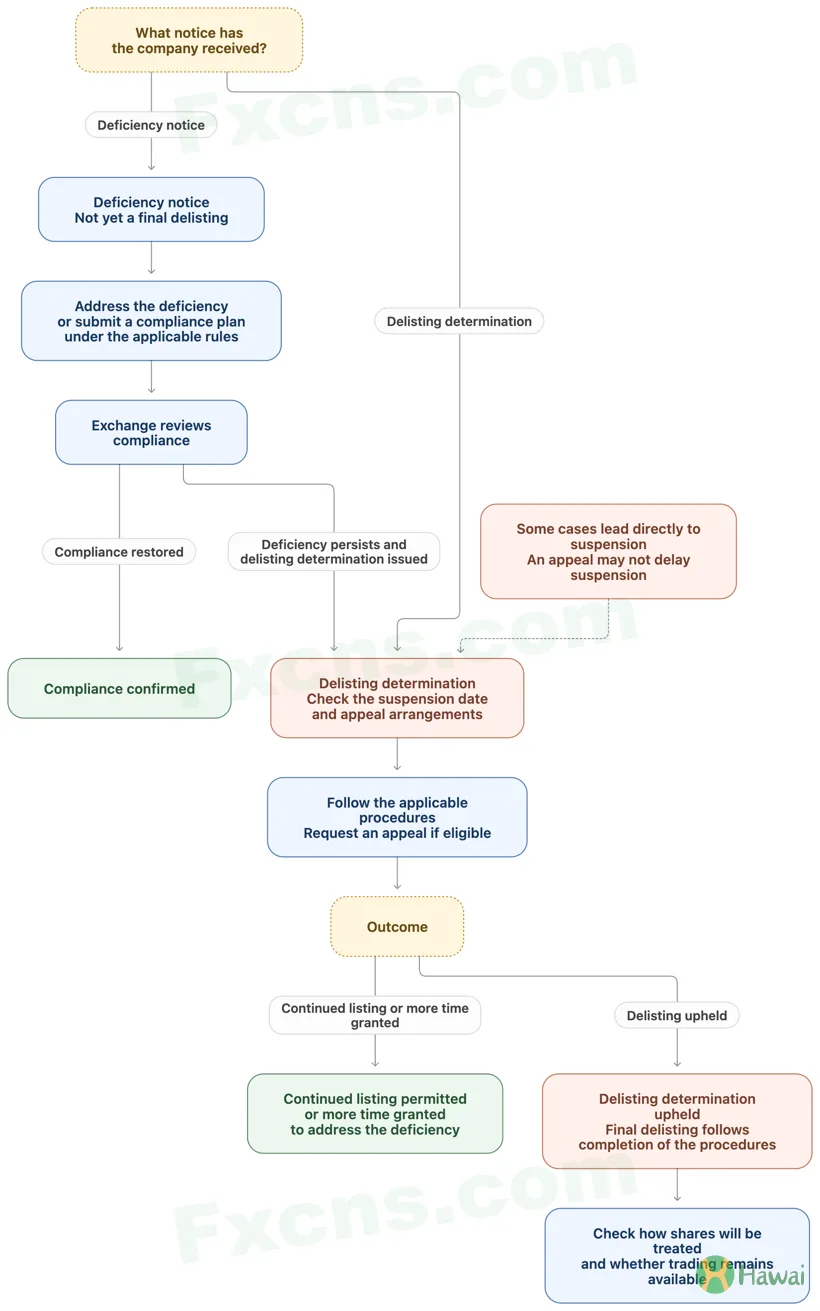
Illustration of common procedures for delisting due to noncompliance with continued listing requirements. The exchange’s notice governs the applicable process. Final delisting does not automatically cancel shares or guarantee OTC trading.
Four details to find in the announcement
You do not need to read the entire exchange rulebook first. Start by finding these four details in the current announcement:
- Reason: Which requirement has not been met—price, a financial threshold, financial reporting or something else?
- Stage: Is this a deficiency notice or a delisting determination?
- Dates: What are the compliance deadline, appeal deadline and trading suspension date?
- Share arrangements: Will a trading route remain available? Is there a cash acquisition, share exchange or cancellation of shares?
These dates are not interchangeable. In particular, do not treat the company’s compliance deadline as a guaranteed last day on which you can sell.
4. Worked examples: a sub-$1 price, a reverse split and selling after delisting
All figures below are hypothetical and do not describe any particular company.
A price below $1 does not make your holding disappear that day
Suppose you hold 100 shares priced at $0.50 each. The value calculated at that price is:
100 shares × $0.50 = $50
A minimum-price deficiency notice does not, by itself, immediately cancel those 100 shares. You need to check the applicable procedure, whether trading is still taking place and subsequent announcements.
That $50 is only a valuation at the price used in the calculation—not a promise that you can sell for $50 at any time. What you can actually receive depends on the available bid prices and quantities.
Does a reverse split that raises the price to $5 create a profit?
Suppose the company carries out a 1-for-10 reverse stock split: every 10 existing shares become 1 new share. Set aside market price changes and fees, and look only at the change in share count and price per share:
| Item | Before the reverse split | Theoretical value after the reverse split |
|---|---|---|
| Shares held | 100 shares | 10 shares |
| Price per share | $0.50 | $5 |
| Position value | $50 | $50 |
The calculation is:
Before the reverse split: 100 shares × $0.50 = $50
After the reverse split: 10 shares × $5 = $50
A reverse split changes the share count and price per share. That action alone does not increase the value of your holding.
The actual trading price can differ from the theoretical value, and the company may have other listing deficiencies. A post-split price above $1 is therefore not enough; check whether the exchange has confirmed compliance.
If an OTC price is displayed, can you definitely sell?
No. OTC means over-the-counter. Not every delisted stock will have ongoing quotes, and your broker may not support trading in it. The SEC’s explanation of OTC securities describes how these securities trade outside an exchange.
Suppose you hold 1,000 shares and the last trade shown was at $0.30. There is currently only one buy order: a bid for 100 shares at $0.20 each.
Under these assumptions:
Position value at the last trade: 1,000 × $0.30 = $300
That buy order can take at most 100 of your shares: 100 × $0.20 = $20 in sale proceeds
A displayed position value of $300 does not mean someone is currently willing to pay $300 for the entire holding. If that is the only buy order, it cannot fill a sale of all 1,000 shares. Further execution depends on new buy orders and the prices they offer.
Three things need to line up: broker support, available bids and sufficient buying interest for the number of shares you want to sell.
5. What to check if you already hold the shares
If trading is still available, establish which options are practical
If the stock still trades on its original exchange, check the current notice and dates before deciding whether to keep holding.
If you plan to sell, look at the actual bids, bid sizes and minimum price you are prepared to accept. A limit order sets a price boundary but may not execute. An order placed is not the same as a position sold.
If you plan to hold, have a clear reason. Is the company simply late filing a financial report, or does it face funding problems, operating difficulties and several listing deficiencies? Time to fix a problem is not proof that the company can fix it. Whether to keep holding depends on the specific issue and progress toward resolving it—not just how far away the deadline is.
Four questions for your broker before suspension or a move to OTC trading
“Do you support OTC trading?” is not specific enough. Give the broker the security’s symbol and confirm:
- This particular security: can you continue holding and selling it, or only view the position?
- Will trading be sell-only, with no new purchases allowed?
- Will existing orders remain active, be canceled or need to be resubmitted?
- If trading is not supported, can the shares be transferred out? Will the receiving broker accept them, and what are the fees and estimated processing time?
Brokers may handle delisted securities differently. For example, Robinhood’s guidance on delisted stocks separately addresses delisted securities and fractional shares. Do not assume one broker’s procedures apply to your own account.
If suspension is approaching, do not count on a transfer as a way to sell before confirming that the receiving broker will accept the shares.
For acquisitions, check what you will receive; for bankruptcy, check what happens to existing shares
If delisting follows an acquisition or a transaction taking the company private, check the cash or shares payable per share, which holders qualify, whether the transaction has closed and whether any elections or documents are required. A proposed acquisition is not cash already credited to your account.
If the company enters bankruptcy reorganization, focus on how the plan treats the existing common stock. Do not infer that your old common shares will recover value simply because the business resumes operations or issues new shares. The SEC explains that new shares issued in a reorganization may be used to settle creditors’ claims, while existing common shares may be canceled. See its guidance on share treatment in bankruptcy.
When dealing with a delisted holding, first check the reason and current stage, then how the existing shares will be treated, and finally whether your broker can support a sale, transfer or acquisition payment. That gives you specific information to look for in a notice, rather than making a buy or sell decision based on the word “delisting” alone.