
NYSE vs. Nasdaq: listings, trading and indexes explained
Disclaimer: For educational purposes only, not investment advice. You are responsible for your investment decisions.
How do the NYSE and Nasdaq differ? Do you need separate accounts to trade stocks listed on each? And why does “Nasdaq” sometimes mean an exchange and sometimes an index?
The NYSE and Nasdaq are U.S. stock exchanges. Their main differences lie in their trading models, listing rules and mix of listed companies. Individual investors generally trade stocks listed on both through a broker; they do not need to open separate accounts with the exchanges.
We will first compare the two exchanges, then distinguish the exchange from the indexes, before using hypothetical figures to show how bid-ask spreads affect trading costs.
1. The main differences between the NYSE and Nasdaq
The New York Stock Exchange, or NYSE, traces its origins to the Buttonwood Agreement of 1792. The Nasdaq Stock Market began operating in 1971, with its roots in electronic markets. Their development is described in the NYSE’s history and Nasdaq’s account of its market development.
Here are the main points of comparison:
| Feature | NYSE | Nasdaq |
|---|---|---|
| Origins | 1792 | 1971 |
| Trading model | Electronic trading combined with a trading floor, floor brokers and designated market makers | An electronic market in which multiple market makers and other participants provide quotes and trade |
| Mix of listed companies | A range of industries, including many large, established businesses | A range of industries, with technology and growth companies attracting particular attention |
| Listing rules | Requirements covering financial measures, public float and corporate governance | Requirements in similar areas, with distinct market tiers |
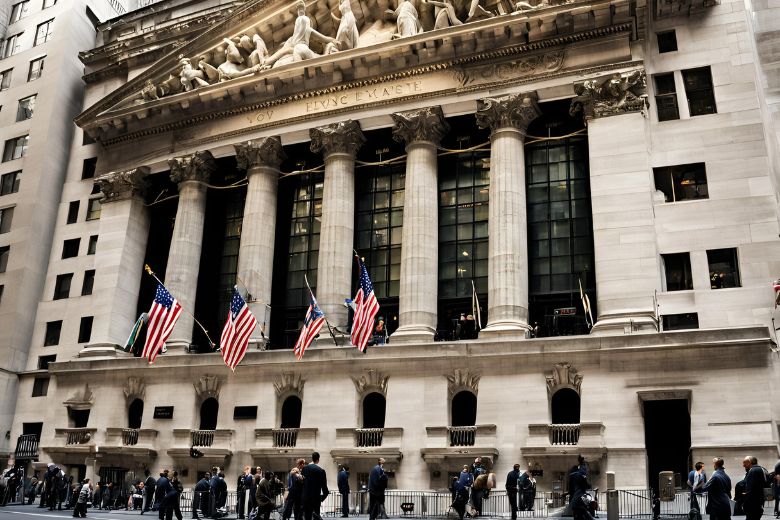
Exterior of the New York Stock Exchange building.
Both exchanges have listing standards, but the requirements that apply to a company depend on factors such as the market tier, security type and the company’s circumstances. Nasdaq, for example, has different market tiers with corresponding financial, liquidity and governance requirements. See the NYSE initial listing standards summary and Nasdaq initial listing guide for details.
2. What do different trading models mean for investors?
What do electronic trading systems and designated market makers do?
The NYSE uses an electronic trading system while retaining its trading floor, floor brokers and designated market maker model.
Designated market makers are known as DMMs. According to NYSE’s explanation of market participants, DMMs have obligations to maintain fair and orderly markets in their assigned securities. They participate in price discovery both manually and electronically at the open, at the close and during trading imbalances.
“Price discovery” means arriving at a price at which trades can take place, based on the prices and quantities buyers and sellers are prepared to accept.
Nasdaq operates as an electronic market, with market makers, order-entry firms and electronic communications networks participating in its trading services. See Nasdaq’s explanation of market participants for details.
For investors, these mechanisms affect how orders participate in matching and opening and closing auctions. When placing a trade, you also need to look at the stock’s current quotes and the quantities available. Section 4 illustrates this with numbers.
How does the listing exchange differ from the execution venue?
Suppose a stock is listed on the NYSE and you submit a buy order through your broker. That order may execute on the listing exchange, or your broker may send it to another exchange or a market maker. The SEC’s explanation of stock order execution describes these different routes.
Three distinct roles are involved:
| Term | Question it answers |
|---|---|
| Listing exchange | Where is the security listed? |
| Execution venue | Where is this particular trade executed? |
| Broker | Who receives your order and provides trading services? |
The listing exchange is information about the security; the execution venue is information about a particular transaction. Orders in the same stock may execute at different venues.
Individual investors generally submit orders through a broker that supports the security. The products, trading sessions and order types available in your account depend on the broker’s services.
3. The Nasdaq exchange, Nasdaq Composite and Nasdaq-100
When you read “the Nasdaq rose,” check which index is meant
The name “Nasdaq” commonly appears in three different contexts:
| Name | What it is | What it tells you |
|---|---|---|
| The Nasdaq Stock Market | A market for securities listings and trading | Where a company is listed and which trading and listing rules apply |
| Nasdaq Composite Index | An index covering eligible Nasdaq-listed stocks | The performance of a broad range of listed stocks |
| Nasdaq-100 Index | An index selecting 100 large non-financial companies under its rules | The performance of this group of large non-financial companies |
Under the Nasdaq Composite methodology, the Composite includes eligible common-type securities listed on Nasdaq, without an industry restriction. It covers technology and other sectors.
The Nasdaq-100 is more selective, covering 100 eligible large non-financial companies. Technology is a major component, alongside other sectors such as consumer businesses and healthcare. See Nasdaq’s official introduction to the Nasdaq-100.
A news report saying “the Nasdaq rose” and a fund description referring to the Nasdaq-100 may therefore mean different indexes. Check the full name before comparing returns or choosing a product.
How does owning a Nasdaq-listed stock differ from owning an index fund?
If you buy shares in a Nasdaq-listed company, you own stock in that company. Its business performance and share price directly affect the value of your holding.
If you buy an index fund tracking the Nasdaq-100, you own units or shares in the fund. The fund seeks to track the index’s performance according to its investment objective and strategy.
The first primarily exposes you to one company; the second holds a group of securities, but its sector and individual-stock concentration still matter. The number of companies, their weights and their industry mix all affect the portfolio’s performance.
To invest in an index, you generally select a fund or another product that tracks it. Beyond identifying the index, compare the strategy and costs. The SEC’s explanation of index funds notes that fees, trading costs and tracking error can cause fund returns to differ from the index.
4. What should an individual investor actually compare?
For stocks, examine the business, finances and price
Before buying an individual stock, answer a few specific questions:
- How does the company make money? Do its revenue and profits depend on a small number of customers or products?
- Can its cash flow support operations, and does its debt create significant pressure?
- What valuation does the current price imply, and how much growth is already priced in?
- After the purchase, what proportion of your investment capital would this holding represent?
For example, two companies may be listed on the same exchange, with one consistently generating cash and the other relying on external financing. When comparing them, investigate how much funding the latter needs, what it will fund and how long its existing cash can support operations.
For funds, check the benchmark and portfolio composition
When choosing an index fund, work through these points:
- Check the full index name first. Is it the Nasdaq Composite, the Nasdaq-100 or another similarly named index?
- Look at the actual holdings and weights. Which sectors account for the largest shares, and how concentrated are the top holdings?
- Then compare fees and tracking performance. Funds tracking the same index can have different costs and tracking results.
- Finally, check trading conditions. Does your broker support the product? How wide is the bid-ask spread, and is sufficient quoted size available?
The investment objective, benchmark and portfolio details in the fund’s documents help establish what you would actually own.
When placing an order, check prices, size and the spread
A simple way to think about liquidity is to ask: can you trade the number of shares you want at or near a price you are prepared to accept?
The following hypothetical stocks illustrate the bid-ask spread:
| Item | Stock A | Stock B |
|---|---|---|
| Current bid | $50.00 | $50.00 |
| Current ask | $50.01 | $50.10 |
| Bid-ask spread per share | $0.01 | $0.10 |
| Spread amount for 100 shares | $1 | $10 |
The bid is the price a buyer is willing to pay; the ask is the price a seller is willing to accept.
Assume that quotes do not change, sufficient shares are available at those prices and you buy 100 shares and immediately sell them. You buy at the quoted ask and sell at the quoted bid, excluding other fees:
Stock A: 100 × (50.01 − 50.00) = $1
Stock B: 100 × (50.10 − 50.00) = $10
These amounts are the losses from crossing the spread on a buy-and-sell round trip under the stated assumptions—not broker commissions. Even with zero commission, the spread can affect your trading result.
Quoted size matters too. If only 10 shares are offered at the current ask, you cannot assume that all 100 shares can be bought at that price. A limit order sets an acceptable price but does not guarantee a complete fill.