Do U.S. stocks have daily price limits? Circuit breakers, trading pauses and orders
Disclaimer: For educational purposes only, not investment advice. You are responsible for your investment decisions.
Why can a U.S. stock keep trading after rising 20% in a day? Why might another stock suddenly stop trading even though its daily price change looks modest? How long will the pause last, and can orders already placed still execute?
The key distinction is this: U.S. stocks do not share a universal fixed daily price limit, but individual securities are subject to price bands, and market-wide circuit breakers can halt trading across the market. The single-stock mechanism addresses rapid price movements over a short period. Market-wide circuit breakers depend on how far the S&P 500 has fallen from its previous trading day’s close.
We will first separate these two mechanisms, then use hypothetical figures to show how they are triggered, before explaining what pauses and reopening mean for orders. This article focuses on regular trading hours, 9:30–16:00 U.S. Eastern Time (ET). The rules were checked as of October 31, 2026.
1. Do U.S. stocks have daily price limits? Three situations to distinguish
When you see a trading halt, first establish whether it affects one security or the wider market, and what caused it.
| Situation | What determines it | Scope |
|---|---|---|
| A pause caused by single-stock volatility | Quotes in relation to dynamic price bands | The affected stock or other eligible security |
| A market-wide circuit breaker | The S&P 500’s decline from its previous close | An equity trading halt across markets |
| A news or regulatory halt | Company announcements, regulatory requirements and exchange notices | The affected security |
Single-stock price bands change over time. They do not mean that a stock can rise or fall by no more than 10% in a day. A daily move of more than 10% does not, by itself, breach the rules.
Not every halt is caused by price volatility. For example, in Nasdaq’s trading halt codes, T1 means news is pending, T12 means additional information has been requested from the company, and LUDP identifies a volatility trading pause. Different reasons for a halt come with different conditions for resuming trading.
The following sections explain volatility-related rules. If you encounter a halt, use its reason code to identify the relevant notice.
2. Single-stock price bands limit current execution prices, not the entire day’s move
How are the price bands calculated?
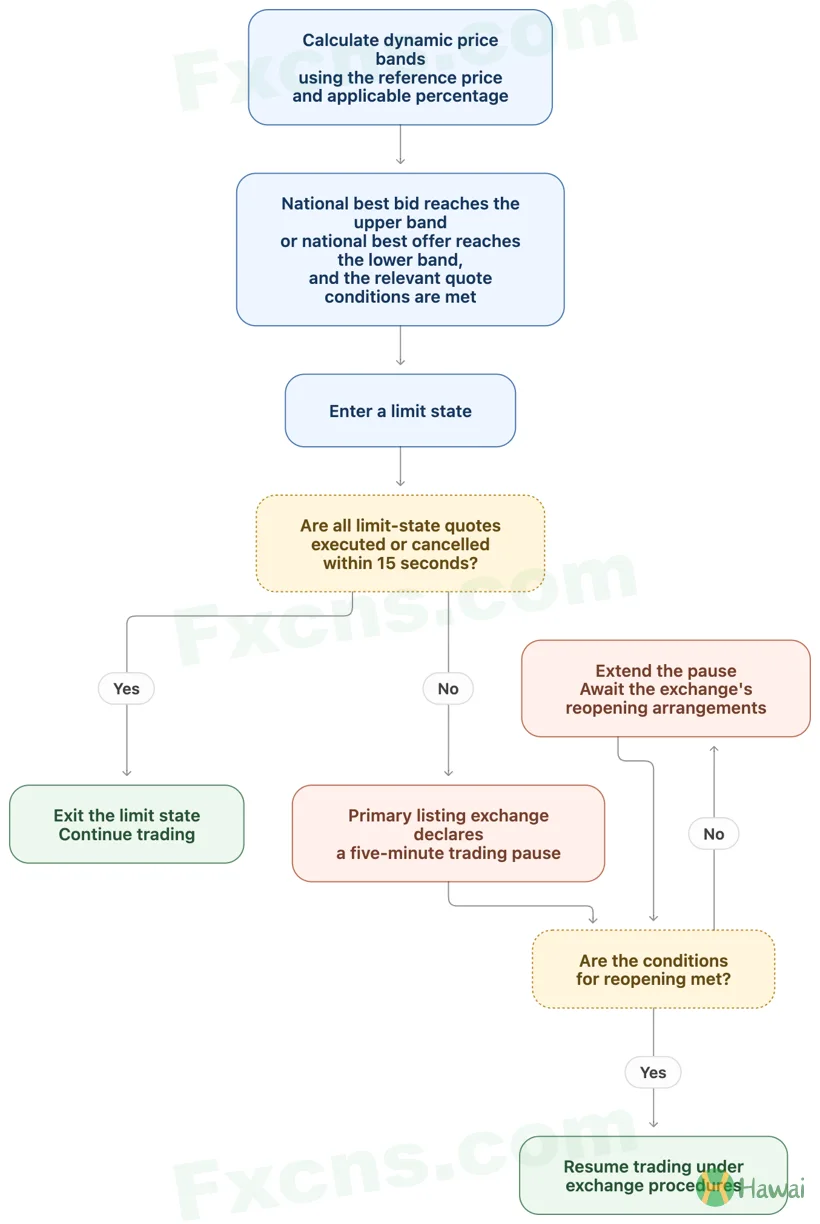
The single-stock mechanism is called Limit Up/Limit Down, or LULD. It uses a reference price to calculate the upper and lower bounds for permitted trades at that time.
According to the official LULD explanation, the reference price generally reflects the average price of eligible trades over the preceding five minutes and is updated under the plan’s rules. The percentage applied depends on the security’s classification, price and trading session; it is not always 10%.
Two common cases are:
| Security classification | Common percentage when the previous closing price is above $3 |
|---|---|
| Tier 1 securities, including S&P 500 and Russell 1000 constituents and selected exchange-traded products | 5% |
| Other eligible securities classified as Tier 2 | 10% |
The 5% figure for Tier 1 securities in this table applies from 9:30 to 15:35 on a regular trading day. Wider bands apply near the close. Lower-priced securities also have different parameters, so these two percentages cannot be applied to every security.
The basic calculation is:
Current upper band = reference price × (1 + applicable percentage)
Current lower band = reference price × (1 − applicable percentage)
When the reference price updates, the bands change too. Section 4 uses a $100 example to show why this is different from a fixed daily price limit.
Does reaching a band immediately trigger a pause?
Not necessarily. A limit state and a trading pause are different stages.
A security enters a limit state when the national best bid reaches the upper band, or the national best offer reaches the lower band, and the relevant quote conditions are met. The limit state can end if all the limit-state quotes are executed or cancelled within 15 seconds.
If the limit state does not end within 15 seconds, the primary listing exchange declares a five-minute trading pause. Trades in the security cannot execute during the pause. NYSE’s explanation of how LULD works describes the distinction between these stages.
A single trade at the upper band therefore does not establish that a five-minute pause has begun. You also need to check the quote conditions and whether the exchange has declared a pause.
Does trading always resume after five minutes?
Five minutes is the initial pause period, not a guaranteed countdown to reopening.
The exchange must process buy and sell orders under its reopening rules. If the reopening auction cannot be completed, the pause can be extended. Near the end of the session, the applicable closing procedures may take over. See NYSE’s explanation of pause extensions and reopening for details.
In an actual pause, follow the exchange’s reopening notice rather than assuming trades will execute as soon as five minutes have passed.
3. Market-wide circuit breakers measure the S&P 500’s decline from its previous close
What do the 7%, 13% and 20% thresholds mean?
Market-wide circuit breakers use the S&P 500’s closing value on the previous trading day as their baseline.
The official NYSE circuit breaker FAQ sets out the main rules:
| Level | Decline from the previous close | Timing and trading arrangements |
|---|---|---|
| Level 1 | 7% | Before 15:25 ET: a halt of at least 15 minutes |
| Level 2 | 13% | Before 15:25 ET: a halt of at least 15 minutes |
| Level 3 | 20% | Trading does not resume that day |
Level 1 and Level 2 can each trigger only once per trading day. Reaching either threshold at or after 15:25 does not trigger a Level 1 or Level 2 halt. Level 3 is not subject to that cutoff.
The trigger is the index’s decline—not a 7% drop in an individual stock or the price change of an S&P 500 ETF.
Calculating the thresholds from a hypothetical 6,000-point close
Suppose the S&P 500 closed at 6,000 on the previous trading day:
| Level | Calculation | Index level |
|---|---|---|
| Level 1 | 6,000 × (1 − 7%) | 5,580 |
| Level 2 | 6,000 × (1 − 13%) | 5,220 |
| Level 3 | 6,000 × (1 − 20%) | 4,800 |
Suppose the index first falls to 5,580 in the morning, triggering a Level 1 halt. After trading resumes, it continues falling. It reaches the Level 2 threshold at 5,220, which is 13% below the previous close.
Level 2 does not mean a further 13% decline from the Level 1 trigger. All three thresholds use the same previous closing value.
If the index rebounds after a Level 1 halt and later returns to a 7% decline, that does not trigger another Level 1 halt that day.
Why “at least 15 minutes”?
Following a market-wide halt, affected securities still have to go through reopening procedures. They do not all necessarily resume continuous trading at the 15-minute mark. NYSE’s reopening arrangements explain that reopening auctions can take place no earlier than 15 minutes after the halt, and some securities may take longer.
A Level 3 halt should not be interpreted as permission to switch to another session after 16:00 that day. The NYSE rule filing published by the SEC specifies that trading after a Level 3 halt cannot resume before 4:00 ET on the next trading day. Each market’s reopening remains subject to its own schedule.
4. A worked example: a stock with a $100 reference price
This example covers single-stock LULD only, not market-wide circuit breakers.
Assume that:
- The time is 10:00 ET.
- The stock is subject to 5% price bands.
- The current reference price is $100.
- The reference price and bands have not yet updated during the brief sequence below.
Calculate the current bands
Upper band = 100 × 1.05 = $105
Lower band = 100 × 0.95 = $95
The current permitted range is $95–$105. Trades subject to these bands cannot execute outside that range.
Even if you are willing to buy at $106, that does not mean a trade can execute at $106 at that moment. Your willingness to pay more does not change the current upper band.
Two possible outcomes at $105
Suppose the national best bid rises to $105 and the quote conditions for a limit state are met:
| What happens next | Result |
|---|---|
| All limit-state quotes are executed or cancelled within 15 seconds | The limit state ends; a trading pause is not necessarily triggered |
| The limit state has not ended after 15 seconds | The primary listing exchange declares a five-minute trading pause |
$105 is the upper band at that moment, not the maximum price allowed for the entire day.
If no pause occurs and the reference price subsequently updates to $105 under the rules, with the applicable percentage still at 5%, the new bands are:
Upper band = 105 × 1.05 = $110.25
Lower band = 105 × 0.95 = $99.75
A stock can therefore keep rising as its reference price changes, even with 5% bands. The 5% figure is not a cap on the day’s cumulative gain.
Who determines the price when trading resumes?
At reopening, buy and sell orders are processed under the exchange’s auction and other applicable rules. You cannot assume that the last price before the pause will carry over.
For example, if the last trade before the pause was at $105, the first trade after reopening still depends on the buy and sell interest at that time. The earlier price does not establish a fixed range for the reopening price.
The useful distinction for investors is: you can check the pause period, but you cannot infer the reopening execution price from the last pre-pause trade alone.
5. What do pauses and reopening mean for your orders?
Submitting an order, having it accepted and getting a fill are different things
No trades can execute during a halt, but that does not mean every market stops accepting orders.
For example, NYSE’s guidance on order handling during market-wide halts explains that new orders, existing orders and cancellation requests are handled according to the security and order type. Some are accepted; others are cancelled or rejected.
An order marked “submitted” or “accepted” is therefore not a completed trade, nor is it guaranteed to execute when trading resumes.
Before changing an order, confirm its current status and whether the change request has been accepted. Do not repeatedly submit the same trade simply because you have not yet received an execution report.
A limit order controls price but does not guarantee a fill
Suppose the last trade before the pause was at $105 and you have a buy limit order at $104.
If the available selling prices after reopening are all above $104, your order will not automatically raise its limit to secure a fill. It can execute only when a sell order meets its price and other execution conditions.
A limit order sets the price boundary you are prepared to accept. It does not guarantee that you will be able to buy or sell.
A stop price is not a guaranteed execution price
A standard stop order becomes a market order when triggered, and its execution price may differ from the stop price. FINRA’s guidance on stop orders cautions that the difference can be substantial in a fast-moving market.
Suppose you own 100 shares and set a sell stop at $95. If the stock gaps down and available execution prices are already around $90 when trading resumes, your sale price may be well below $95.
A stop-limit order involves a different trade-off. Suppose its stop price is $95 and its minimum selling price is $94. If all bids after reopening are below $94, the order may not execute.
| Order type | Main trade-off |
|---|---|
| Standard stop order | Becomes a market order when triggered; the execution price may differ from the stop price |
| Stop-limit order | Sets an acceptable price limit but may remain unfilled |
The exact trigger method and eligible trading sessions depend on your broker’s order terms.
A practical sequence when you encounter a halt
First, check the cause: single-stock volatility, a market-wide circuit breaker, company news or regulatory action. You can look up records in Nasdaq’s trading halt search and confirm the details against the exchange’s notice.
Next, check the reopening arrangements. A five-minute single-stock pause, a market-wide halt of at least 15 minutes and a news halt do not share one waiting period. Quoting and trading may also resume at different times.
Finally, check your orders: whether an existing order is still active, whether a cancellation succeeded and whether your limit price still fits your plan. The last displayed price before reopening is not a promise of the next execution price.
To understand a U.S. trading halt, check its cause, then its reopening conditions, and finally how your orders will be handled. That turns the rules into something you can use, rather than a list of figures such as 5%, 10% or 15 minutes.